Soomin Lee

Soomin Lee

Efficient AI systems · Algorithm–hardware co-design

I study how algorithms and their hardware implementations can be designed together to make computation more efficient. My work spans multimodal systems, energy-efficient edge AI inference, and algorithm implementation on FPGAs and ASICs.

Research

TaRo

Purdue UniversityCVPR 2027 · Under review

Temporal candidate reuse for streaming video-language models

Reuse promising KV candidates across video frames, then rescore them with the current query while retaining the complete KV history. TaRo achieved 1.37–3.58× LLM-prefill speedups over ReKV in the evaluated settings.

View original figure
Original figure

Temporal candidate reuse in streaming prefill
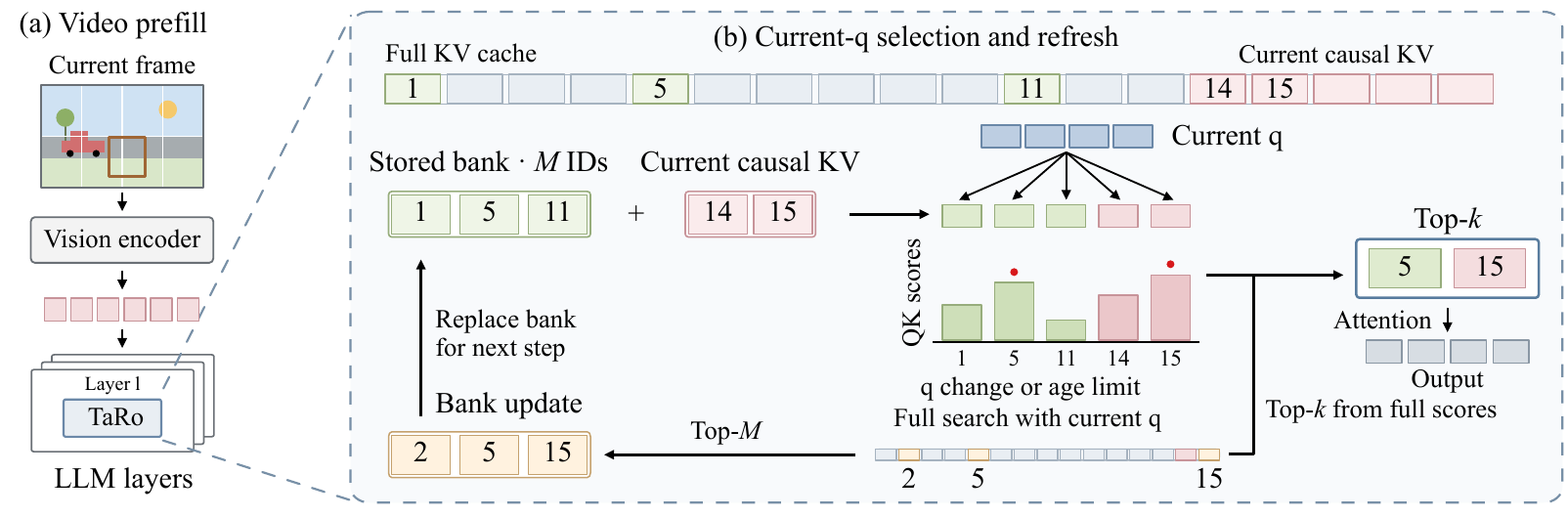
TaRo Figure 3: video frames pass through a vision encoder into TaRo-equipped LLM layers. Stored indices 1, 5, 11 and current causal keys 14, 15 are rescored with the current query. Top-k feeds attention; a full-history search refreshes the bank when the query changes or the bank reaches its age limit.

The original paper figure shows where TaRo runs in video prefill and how candidate reuse works. Stored candidate indices and current-frame causal keys are rescored with the current query; the selected Top-k entries feed attention. Query change or bank age triggers a full-history search and bank refresh. The illustrated bank size, key IDs, and scores are schematic.

TaRo manuscript · Figure 3 · Under review

EdgeVQA

Purdue · POSTECH collaborationDAC 2027 · Under review

Sustaining video and answer rates on bandwidth-limited devices

Process video frames and verify draft answers in one model-weight sweep, with adaptive chunk sizing to keep answers moving. The evaluated design reduced modeled bandwidth for 10 frames/s and 3 tokens/s from 55.5 to 23.0 GB/s.

View project flow
DAC 2027 · Under review

One weight sweep, two ongoing tasks

Scroll to follow the full flow ↔

An adaptive scheduler combines incoming-video processing and draft-answer verification in a shared weight sweep. Answer progress guides the next video chunk size.

An adaptive scheduler combines incoming-video processing and draft-answer verification in a shared weight sweep. Answer progress guides the next video chunk size.

Scope and reading notes

The two tasks share target-model linear-layer weight reads while preserving separate attention contexts, positions, and KV state. Frames are committed even if draft tokens are rejected; only accepted answer tokens are committed. The diagram summarizes the execution policy; modeled system rates and FPGA timings are distinct evaluations. Solid arrows show data; dashed arrows show control or scheduling.

HEED

Purdue UniversityResearch project

Workload prediction and DVFS for energy-efficient edge AI

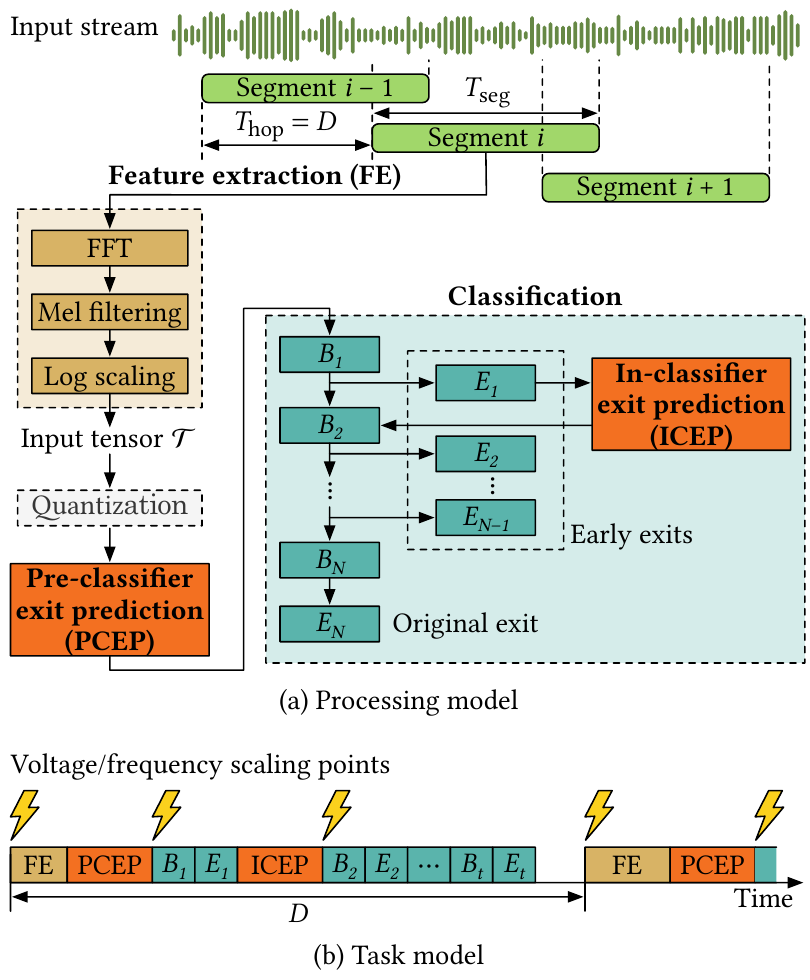
Predict the required network depth from temporal continuity, then adjust voltage and frequency to meet each deadline. HEED saves 16.17–17.55% energy versus EENet at matched accuracy in the evaluated MCU audio streams.

View original figure
Original figure

Early exit prediction and voltage/frequency scaling

HEED Figure 1: overlapping audio segments pass through feature extraction and pre-classifier prediction, then a classifier with early exits and an in-classifier fallback; a task timeline marks voltage/frequency scaling points.

The original paper figure connects the processing path to the execution schedule. Pre-classifier exit prediction estimates the required depth before the network runs; an in-classifier predictor handles the fallback case. The lower timeline shows where voltage and frequency can change as the workload becomes known. Block lengths are schematic.

HEED manuscript · Figure 1

TESSERA

Purdue UniversityIISWC 2026 · Published

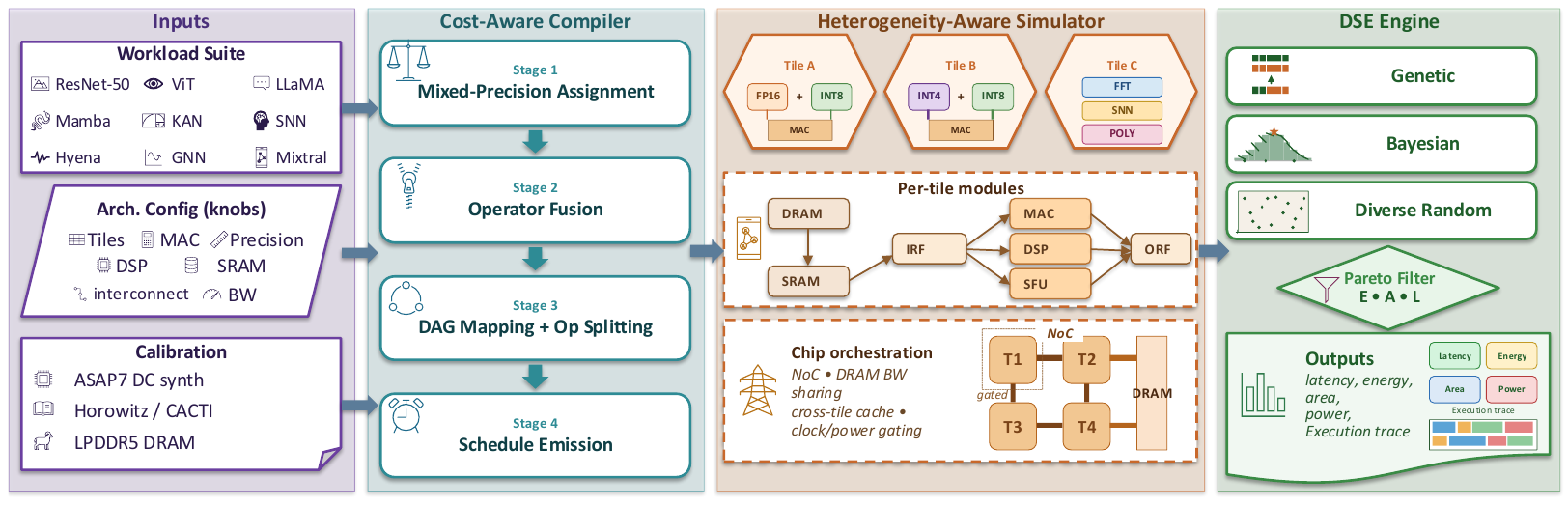
Workload-driven heterogeneous NPU exploration

Explore how large, small, and special-function tiles can work together in heterogeneous NPUs. I built the preliminary exploration prototype and co-authored the IISWC 2026 paper.

View original figure
Original figure

The TESSERA exploration framework

TESSERA Figure 4: workload and architecture inputs plus calibration feed a cost-aware compiler, a tile and chip-level simulator, and a design-space-exploration engine.

The published framework takes a workload and architecture configuration, compiles an execution plan, and estimates its cost with a heterogeneity-aware simulator. Calibration supplies the hardware cost models; the DSE engine compares candidate designs and filters the latency, energy, and area tradeoffs. This is the final collaborative framework.

TESSERA · IISWC 2026 · Figure 4 ↗

Industry

Algorithm–hardware co-design at LG Display, from compact data representations and physical models to RTL and FPGA validation.

Hardware-aware compression

LG Display · 2023–2024RTL / ASIC

Vector quantization and memory dataflow co-design

Co-design vector quantization and memory dataflow for per-frame display compensation. Achieved 8:1 data reduction and reduced DDR channels from two to one.

View project flow
Project diagram

From compensation blocks to compact indices

Vector quantization example: the input block 8, 7, 8, 8 matches codebook row 1, which stores 8, 7, 8, 7. The block is stored as index 1; a DDR index retrieves the shared SRAM vector to reconstruct the block.

Each block of compensation values is represented by the index of its nearest shared code vector. During operation, indices in DDR select vectors from the SRAM codebook to reconstruct the values. Green traces one example block; numbers and block sizes are illustrative.

Vector quantization and runtime memory placement

Real-time thermal estimation

LG Display · 2025RTL handoff

From a physical model to a hardware datapath

Turn video-derived current maps into pixel-level temperature estimates using 2D heat diffusion. Adapted the model for real-time hardware and completed RTL handoff.

OLED degradation modeling

LG Display · 2024–2025Applied ML

Predictive models and interpretable compensation parameters

Model OLED degradation with machine learning and generate compensation parameter maps. Explainable AI helps identify the factors behind the predictions.

Publications & manuscripts

Experience

Purdue University

Research Assistant · Electrical & Computer Engineering

Networked and Embedded Intelligent Systems Lab. Advisor: Prof. Younghyun Kim.

LG Display

Research Engineer · Circuit & Algorithm Research, Advanced Technology Research Institute

Display algorithms, microarchitecture, Verilog RTL, FPGA validation, and ASIC integration.

Seoul National University

Undergraduate Researcher · Computer Architecture and Parallel Processing Lab

Advisor: Prof. Hyuk-Jae Lee

Education

Purdue University

M.S. in Electrical and Computer Engineering

Chung-Ang University

B.S. in Electrical and Electronics Engineering