01 / THE PROBLEMWhich tile mix makes better use of a fixed hardware budget?
A uniform array of MAC-centric NPU tiles works well for some dense neural networks, but newer workloads spend substantial time on vector operations, FFTs, spiking integration, and polynomial evaluation. Adding specialized tiles creates a large design space: tile counts, precision, memory, dataflow, and operator mapping interact. A fair comparison must account for the shared chip-area and memory-bandwidth budget.
02 / THE APPROACHCompare complete workload–architecture combinations
01Describe the workload and tile mix
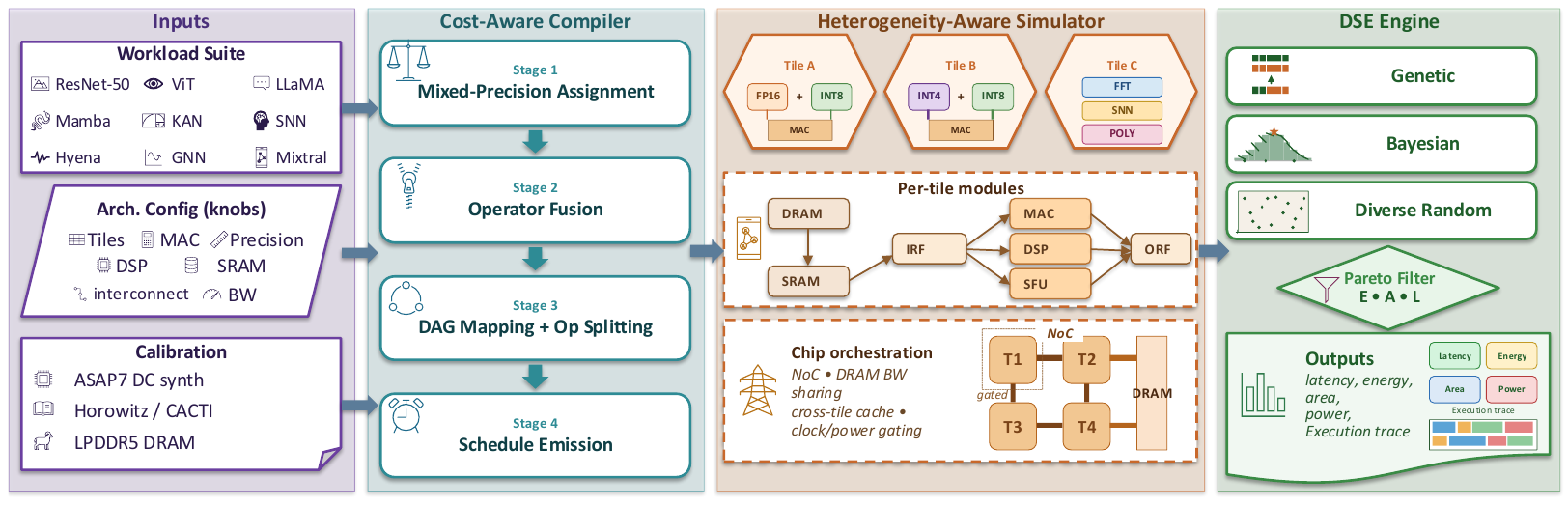
The framework represents AI workloads as operators and explores combinations of Big, Little, and Special-Function tiles. Architectural choices include array size, precision, SRAM, dataflow, sparsity, and support for non-MAC operations such as FFTs and spiking or polynomial primitives.
Compile a cost-aware execution plan
The compiler assigns precision, fuses compatible operators, maps the operator graph, and splits work across compatible tiles when the cost model predicts a benefit. Mapping considers completion time and data movement, so peak arithmetic throughput alone does not determine the tile choice.
Simulate shared resources and search the design space
Analytical models estimate tile-level execution and chip-level orchestration, including interconnect and shared DRAM bandwidth. Synthesis-based calibration grounds the costs. A stratified sweep followed by genetic-algorithm refinement searches for Pareto-efficient configurations under common area or latency constraints.
03 / MY CONTRIBUTIONThe preliminary exploration prototype
I built the preliminary heterogeneous multi-tile NPU exploration prototype as a Purdue course research project, including synthesis-calibrated cost models and controlled architecture comparisons. I am a co-author of the published IISWC 2026 paper.
NPU architectureDesign-space explorationHardware modeling
04 / EVALUATIONSetup and results
The published collaborative framework evaluates 20 workloads, calibrates cost models to a 7 nm node, and cross-validates against NVDLA. Iso-area comparisons hold the chip budget fixed while changing the composition of compute tiles. My contribution was the earlier Purdue course prototype, including synthesis-calibrated cost models and controlled architecture comparisons.
- Mean modeled energy savings
- 46.91%
- Best general-purpose heterogeneous design versus the best iso-area homogeneous baseline.
- Chip-area budget
- ≈200 mm²
- For the reported Big + Little + Special-Function design.
- Evaluation suite
- 20 workloads
- Including dense, vector-heavy, and non-MAC computation patterns.
05 / OUTCOME & SCOPEA workload-driven choice of tile heterogeneity
The published results show how reallocating a fixed silicon budget can serve a broader workload mix more efficiently than replicating one tile type. These are calibrated simulation and design-space-exploration results. The final framework and its reported gains are collaborative work; they should be distinguished from my preliminary course prototype and from measurements on fabricated silicon.